
Crypto and forex can both move quickly, but they are not the same type of decision. Crypto gives you exposure to digital assets and, in many cases, direct responsibility for how they are stored. Forex is the market for exchanging one national currency against another, usually through a broker and often with leverage. The better choice is not the market that is making the loudest moves today. It is the one whose risks, time demands, and rules you can explain before you put money at risk.
This guide is educational, not personal investment advice. Neither crypto nor forex is automatically “better,” and neither is a shortcut to reliable income. Your emergency fund, high interest debt, local rules, tax position, experience, and ability to tolerate losses matter more than a social media prediction. A sensible first step is to decide whether you are looking for a long term investment, a market to study, or a short term trading activity. Those are different goals and should not be funded in the same way.
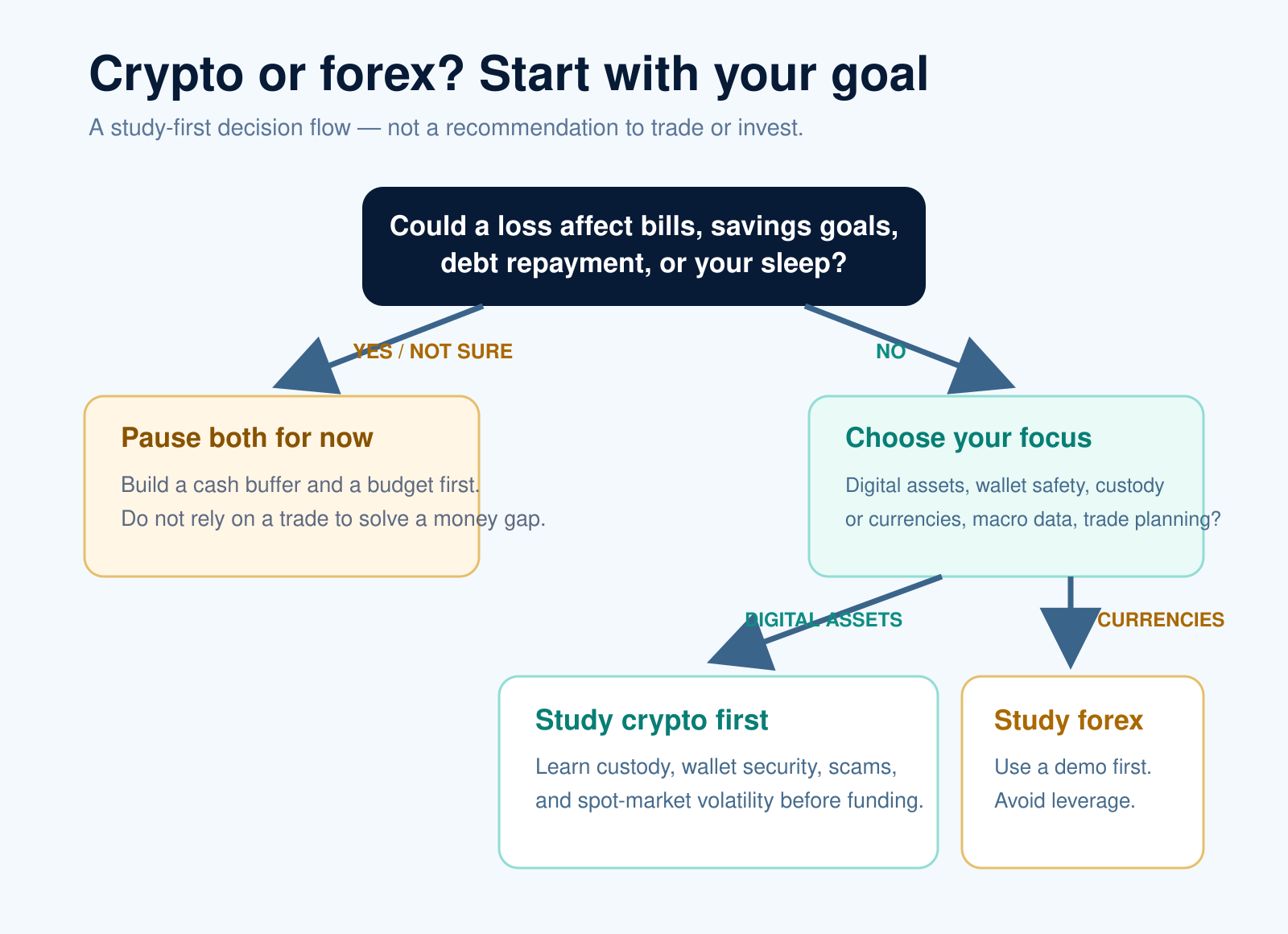
Short answer: If you cannot afford a meaningful loss, do not start with either market. If you are still learning, begin with research, a written plan, and a very small amount of money—or a demo environment where available. Do not borrow money or use high leverage to “catch up.”
Crypto and forex: what are you actually buying or trading?
When you buy spot crypto, you are acquiring a digital asset such as Bitcoin or Ether. You can leave it with a platform, move it to a wallet, or sell it later. This means you need to understand price risk as well as platform, custody, private key, and scam risk. If you are new, start with what cryptocurrency is and read our crypto wallet guide before opening an account.
Forex trading usually means taking a view on one currency relative to another, such as whether one currency may strengthen or weaken versus another. Retail forex is commonly offered through brokers as contracts or margin products rather than as a long term holding of cash. A small move can have an outsized effect when leverage is used. The U.S. Commodity Futures Trading Commission explains that retail forex customers must understand the dealer relationship, fees, and leverage risks; its forex customer advisory is a useful independent starting point.
Crypto vs. forex at a glance
| Factor | Crypto | Forex | Why it matters for a beginner |
|---|---|---|---|
| What moves the market | Adoption, network activity, liquidity, regulation, sentiment, and macro conditions | Interest rates, inflation, economic data, central bank policy, trade, and geopolitical events | Choose the market whose drivers you are willing to study consistently. |
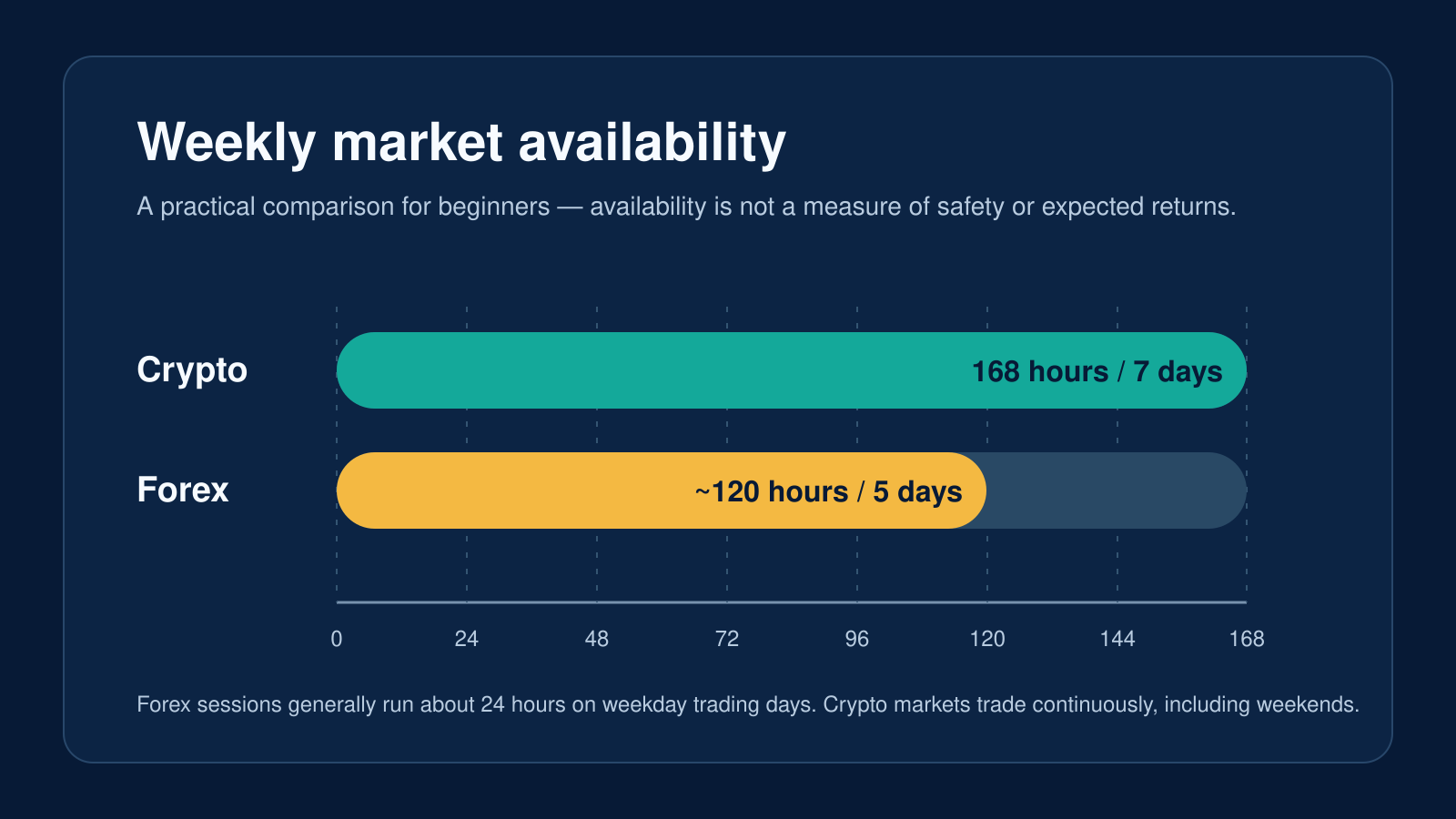
| Market hours | Usually trades 24 hours a day, seven days a week | Typically active around the clock on weekdays, with a weekend close for most retail products | Always open markets can create pressure to monitor prices. A plan needs clear limits. |
| Custody | You may control a wallet and private keys, or rely on a platform | Your position is generally held through a broker account | Crypto adds wallet and recovery responsibilities; forex adds broker and counterparty due diligence. |
| Leverage | Optional on some platforms but can sharply increase liquidation risk | Commonly offered in retail products and can magnify losses quickly | Leverage is not a beginner advantage. It reduces room for mistakes. |
| Main non price risks | Hacks, phishing, lost access, platform failure, token specific risks | Over leverage, spread and financing costs, broker quality, fast news moves | Price direction is only one part of risk. |
| Long term holding | Possible, but volatility and custody must be acceptable | Less commonly approached as a simple long term investment by retail traders | Match the product to your intended holding period. |
Decision chart: which path fits your situation?
When crypto may make more sense
Crypto may be the more relevant market to research when you are interested in the technology and accept that the position may be volatile for long periods. It can be easier to understand the basic act of buying a small spot position than to understand a leveraged currency contract. That does not make it low risk. Official investor guidance warns that crypto assets can be exceptionally risky and volatile, and that platforms may not provide the protections investors expect. Review the SEC’s crypto asset risk alert before you fund an account.
Crypto may be a reasonable topic to study first if you can answer the following questions:
- Can you explain what the asset does without relying on a price target?
- Would you be comfortable holding a small position through a large drawdown?
- Do you know the difference between keeping assets on a platform and using self custody?
- Can you identify a phishing attempt and verify an address before sending funds?
- Have you decided in advance how much of your overall money you are willing to risk?
If you cannot yet answer those questions, do not rush. Read the first Bitcoin buying guide, compare platforms with our exchange checklist, and review the common crypto scams guide. The most expensive beginner error is not missing a move; it is sending money to the wrong person, using a weak security setup, or buying more than you can afford to lose.
When forex may make more sense
Forex may be the market you study when you prefer economic research and structured trading rules. Currency pairs react to central bank decisions, inflation data, employment reports, and changes in risk sentiment. Many traders build routines around specific sessions and planned economic releases. This can be appealing if you enjoy tracking a limited number of variables and recording every trade.
However, forex is not automatically safer because major currencies can appear more familiar than crypto. Retail forex products can involve leverage, spreads, commissions, overnight financing, and dealer or broker risk. The CFTC notes that forex customers should check the registration status of the firms they use and understand who is on the other side of the trade. In practical terms, a beginner should treat leverage as a risk amplifier, not as a way to trade a larger position with a small deposit.
Forex study may fit you better if you:
- Prefer following economic calendars and central bank decisions over token news;
- Can keep a fixed schedule instead of trading every price movement;
- Are prepared to use a demo account first and document your entries, exits, and mistakes;
- Understand that a stop loss can limit risk but cannot guarantee the exact exit price in a fast market; and
- Will choose a properly regulated provider that serves your country.
The risk comparison most people miss
Crypto risk is often discussed only as volatility. That misses custody. With self custody, you control access through private keys or recovery information. Losing those details, approving a malicious transaction, or sending assets to the wrong address can lead to a loss that is difficult or impossible to reverse. The SEC’s crypto custody bulletin explains why wallet and key security deserve the same attention as the asset itself.
Forex risk is often discussed only as leverage. That misses the behavior leverage creates. A position that is too large can turn a normal market move into an emotional decision. Traders may move a stop, add to a losing position, or trade again immediately after a loss. A written position size rule is more useful than a confident forecast. If you ever consider leveraged crypto trading, use our liquidation price calculator to see how little room a highly leveraged position may have before you place any order.
Use a small, measurable starting plan
Do not decide with a single “crypto or forex” label. Build a plan that can be checked. For crypto, that may mean allocating a small amount on a schedule rather than buying after a sudden price move. You can test the logic using the Crypto DCA Calculator and estimate fees, taxes, and break even points with the Crypto Profit Calculator. For both markets, write down the maximum amount you can lose, the reason for entry, the conditions that would prove you wrong, and when you will review the result.
| Before you fund an account | Crypto checklist | Forex checklist |
|---|---|---|
| Provider check | Research the platform, withdrawal rules, and security options. | Verify that the broker is authorised for your country and read its risk disclosure. |
| Position size | Decide a cash amount you could lose without affecting essentials. | Set a loss limit in money terms before choosing leverage or lot size. |
| Security | Use unique passwords, two factor authentication, and a verified withdrawal address. | Protect the broker account with strong login security and avoid unverified signal groups. |
| Records | Track purchases, sales, transfers, and rewards for tax reporting. | Keep trade confirmations, financing charges, and realised gain/loss records. |
Taxes, scams, and the right next step
Do not leave taxes until after a profitable trade. Crypto transactions, rewards, conversions, and sales may create reporting obligations, while forex treatment can depend on the product and where you live. Read our crypto tax basics and keep clean records from the first transaction. For country specific tax or regulatory advice, use a qualified local professional or your local regulator’s official guidance.
Finally, ignore anyone who tells you that crypto or forex is easy money. Guaranteed return claims, pressure to act quickly, private message “mentors,” and screenshots without verified context are all warning signs. Learning to say “not yet” is a valid investing decision. If you do proceed, start small, avoid leverage until you understand its downside, and review your plan after every trade or purchase rather than reacting to every headline.
Bottom line: crypto or forex?
Choose crypto only if you are comfortable learning about digital assets, custody, and large price swings. Choose forex only if you are willing to study macroeconomic drivers, broker structure, and strict risk management. Choose neither for now if you need the money soon, have not built an emergency buffer, or would be tempted to use leverage to make up for a small account.
For most beginners, education and a written risk limit come before market selection. Start with one small learning goal, use the relevant tools, and protect your capital while you build experience.